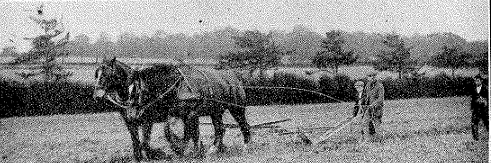
LADS AND THE LAND
Training Boys for Empire
In 1911, a visitor to Hempstead Hall in north-west Essex would have found teenage boys from London milking cows, repairing harnesses and learning the routines of mixed farming. Within weeks, many would have left England altogether, bound for a new life in Australia, New Zealand or Canada.
Few traces of that remarkable enterprise survive today. Yet for more than thirty years, Hempstead Hall formed part of a nationwide network of labour colonies established by religious and philanthropic organisations to tackle unemployment through agricultural training. Their founders believed that fresh air, hard work and rural discipline could restore both character and prospects. Increasingly, they also saw these colonies as a means of preparing young Britons for settlement elsewhere in the Empire.
I began researching Hempstead Hall expecting to write the history of a manor established after the Norman conquest. Instead, I found myself drawn into a much larger story that reached far beyond rural Essex, encompassing social reform, imperial migration and changing attitudes towards unemployment during the first half of the twentieth century.
Labour colonies
The labour colony movement emerged during the late nineteenth century from growing concern over the inadequacy of the Poor Laws. Churches, charities and social reformers argued that simply relieving poverty was not enough. What was needed was rehabilitation through useful work, healthy surroundings and structured communities. Colonies were established for unemployed men, but similar institutions catered for tuberculosis sufferers, alcoholics, epileptics and what contemporaries described as the “feeble-minded”—a reminder that the language and assumptions of the period differ markedly from those of today.
Alongside these humanitarian ambitions lay a more pragmatic objective. Britain faced persistent unemployment, while the self-governing Dominions were unashamedly seeking ‘white settlers’ to perform agricultural labour. Before the First World War, voluntary organisations worked closely with governments in Canada, Australia and New Zealand to train emigrants for rural life overseas. The war, of course, interrupted the movement but thereafter it gained traction again, until the financial crash of 1929 brought things to a halt. By the outbreak of the Second World War, the labour colony movement had largely run its course, with many sites finding entirely different purposes.
Hempstead Hall
Hempstead entered this story in 1905 when the Church Army acquired Hempstead Hall together with approximately 740 acres, including Ruses Farm. Founded only twenty-three years earlier by Wilson Carlile, the Church Army had already established a reputation for practical social work among the urban poor. The reasons for the gift remain uncertain and merit further investigation, although the newly-introduced ‘death duties’ probably played a part.
Work began almost immediately. During the winter of 1905–06, nearly fifty unemployed men were employed preparing the estate for its new purpose. Local newspapers reported that an initial party of twenty-six emigrants had already departed for Canada before the official opening, receiving what one account described as “an address of a cheering nature” from the Vicar of Steeple Bumpstead. Hempstead Hall was formally opened in November 1906 by Princess Louise Augusta of Schleswig-Holstein, signalling the Church Army’s confidence in the scheme.
By 1908, the ‘Farm Colony’ was fully operational, with several locals employed in the training, although progress was halted by a serious fire which destroyed outbuildings and implements. Happily, the loss was fully insured: the damaged wooden and thatched buildings were rebuilt in brick; a barn was repurposed as a bacon factory and a new wing to the house was constructed. This photo from the 1908/9 annual review shows an early group of ‘lads’.

Training for Empire
The Church Army’s annual reports naturally emphasised success. Letters were published from former trainees describing prosperous new lives overseas, reassuring donors that the scheme was achieving its aims. Not every career remained rooted in agriculture. One former Hempstead lad (pictured), writing from HMAS Encounter in Australia, admitted that he felt ‘more at home in [naval] rig than in a flannel shirt and trousers ploughing’; yet he still credited the discipline he had acquired at Hempstead with preparing him for life far from home.
By 1910 Hempstead Hall was no longer simply a farm colony but an Emigration Training Farm, reflecting the Church Army’s growing emphasis on preparing young men for settlement overseas. Canada, once the principal destination, had begun tightening its immigration policies, but opportunities remained in Australia and New Zealand, where demand for agricultural labour continued to grow.
The young men recruited to Hempstead were not being punished. Nor, however, were they experienced farm workers. Many were what might today be termed ‘at risk’. As the Church Army’s annual review put it,
The lads chosen are such as have been put into blind – alley employment by their parents on leaving school, with the result that, at the age of seventeen or eighteen, they find themselves cast on the world, not knowing any trade, and without means of livelihood. Such lads are almost forced into the melancholy army of unemployed; and it is from this source more than from any other that there comes the supply of homeless, starving vagrants who haunt the streets at night, cadging for free soup; and passing on their own miseries to their children and remoter generations.

Supporters argued that emigration benefited everyone involved, and were keen to dispel any suggestion that Britain was exporting its problems to the detriment of other countries. Young men of character and fitness who had struggled to establish themselves in Britain would gain a fresh start, while the Dominions would receive healthy, trained (and white) workers. Edgar Rowan, writing in Wilson Carlile and the Church Army in 1912, argued that those who had become “a burden and a weakness to the Mother Country” might instead become “a source of strength” elsewhere in the Empire.

The Church Army anonymised its published accounts, but the census returns did not. The 1911 census records the names of every young man resident at Hempstead Hall on census night, providing a rare opportunity to trace what became of them.
Harry George Fontana was sixteen years old when the census recorded him at Hempstead. Born in Basingstoke, he left England for Brisbane a few weeks later, travelling with eight other Hempstead trainees on the SS Durham. We can follow him fighting in the war, marrying and working in Queensland and dying in Brisbane in 1974. With luck, descendants of Harry and his fellow emigrants may still preserve memories of the boys’ brief time at Hempstead Hall.
War and a Change of Purpose
The outbreak of war in August 1914 interrupted the colony’s original purpose. Young men who might once have been preparing for farms in Canada or Queensland were now required for military service. As the conflict progressed, the Church Army adapted its work to meet new needs, providing training and rehabilitation for wounded and shell-shocked soldiers invalided from the front.
By 1917 The Times described Hempstead Hall as a training centre for men “broke in the wars”. After preliminary instruction at the Church Army’s market garden in Willesden, trainees moved to Hempstead, where they learnt the essentials of mixed farming before seeking employment. Once again, agricultural work was seen not merely as a livelihood but as a means of rebuilding damaged lives.
Between the Wars
Peace brought a swift return to the Church Army’s original mission. By 1920 the first post-war party of boys had left Hempstead Hall for Australia, with further groups departing for New Zealand and Canada over the following months.
Queensland became a favoured destination. On arrival, the young emigrants were received under arrangements supervised by the Archbishop of Brisbane, while reports sent back to Britain suggested that Hempstead’s practical curriculum matched colonial needs remarkably well. One Emigration Officer singled out instruction in milking, livestock management, carpentry, blacksmithing and the repair of harness and boots as precisely the skills required by employers overseas. The Premier of Queensland asked the Church Army to supply fifty farm-trained boys each month—a striking indication of the confidence then placed in the scheme.

These years represented the high-water mark of the movement. The Wall Street Crash of 1929 transformed the economic landscape. As unemployment rose throughout Britain and opportunities overseas diminished, the assumptions that had underpinned the emigration movement began to unravel. Labour colonies increasingly turned their attention away from preparing young men for new lives abroad and towards dealing with unemployment at home.
The Church Army’s own reports reflected this change in emphasis. By 1930–31 it acknowledged that ‘the training of lads for the Dominions is at a very low ebb’ and accepted that migration should be postponed until economic conditions improved.
From Farm Colony to Remand Home
The decline continued throughout the 1930s. Following the formation of the National Government in 1931, compulsory labour schemes were abandoned, while overseas migration remained depressed. Increasingly, Hempstead Hall found itself adapting to new purposes simply in order to survive.
One of these reflected the Church Army’s continuing concern with family welfare rather than emigration. During the summer months, boys from crowded city neighbourhoods spent fortnightly holidays at Hempstead while their mothers and younger siblings enjoyed periods of respite at the Church Army’s seaside Fresh Air Homes. It was a very different use of the estate, yet one that retained the movement’s original belief in the restorative value of fresh air and the countryside.
The decisive break came in 1941, when Hempstead Hall was redesignated as a remand home for boys awaiting transfer to Approved Schools. Although this was a complete change of function, there were continuities. The emphasis remained on discipline, routine, practical work and supervised living, albeit now within the juvenile justice system rather than a voluntary programme of agricultural training. Hempstead had ceased to prepare boys for new lives overseas; instead, it sought to stabilise young people whose lives had already gone badly wrong.
John Culshaw, the Church Army captain who supervised the home, received consistently favourable inspection reports. Although modern readers may find the official correspondence bordering on the cosy – for example, officials devoted much effort to finding accommodation for Culshaw after the home’s closure – this was probably typical for the time and there is little evidence of serious criticism. Inspectors praised the atmosphere within the home, and a letter from the Home Office in September 1950 referred to the “happy and unrepressive atmosphere” that prevailed there. Culshaw himself later emphasised the absence of serious disciplinary incidents and the remarkably low rate of absconding.
By 1950, however, economics rather than inspection reports determined Hempstead’s future. With only thirty to forty boys in residence at any one time, the cost of maintaining the establishment could no longer be justified, particularly when the average stay was too short to achieve lasting results. The estate was sold, bringing to an end almost half a century of Church Army occupation.
During its ten years as a remand home, Hempstead admitted 1,887 boys, most of them destined for Approved Schools elsewhere. When the institution closed in October 1950, John Culshaw recorded the silence that had descended upon the estate:
No longer is heard the shouting and laughter of noisy boys. The cricket field is deserted, the swimming pool empty, the school and the children are stripped bare. Silence reigns at Hempstead Hall.
Conclusion
Culshaw’s words are a fitting epitaph for an institution whose purpose had repeatedly evolved in response to changing ideas about poverty, unemployment and youth. Founded as an emigration training farm, it became in turn a rehabilitation centre for disabled servicemen, a post-war training school for Empire settlers, a refuge for children from overcrowded cities and finally a remand home for boys.
But in all these guises, the Hall remained a place of transition. Thousands passed through its gates, most staying only briefly before moving on to farms in Queensland, homes in Britain or institutions elsewhere. Few left written accounts, and most remain anonymous. Harry George Fontana is one of the exceptions. From Hampshire to rural Essex and ultimately to Brisbane, his journey reminds us that even a quiet country estate can play a part in the history of empire, migration and social reform.
© Ross Midgley, 2026
With grateful acknowledgements to the CEO of the Church Army and her team.